From rough stone to set jewel
Stones chosen at the source, cut by hand, then set at the bench pin of my workshop. For lapidaries, collectors and jewellers.
 IRough
Crystals and water-worn pebbles, sorted one by one for colour, clarity and cutting yield.
 IICut
Every facet is oriented for brilliance. Weight, dimensions, treatment and origin are documented.
 IIISet
On the jeweller's bench, the stone finds its mount: a ring, a pendant, a one-of-a-kind piece.
A cut calculated, not guessed
Every stone I cut is first modelled in Facet Lab, 3D design software for gemstone cuts. The angles, number and position of the facets are calculated for the refractive index of each material, and the path of light is simulated before the stone ever touches the lap: the result is a very high-precision cut and optimal brilliance.
In mining countries (India, Sri Lanka, Brazil, Madagascar…), many stones are cut to keep as much weight as possible, since they are sold by the carat. Here, the cut serves the brilliance of the stone, not the scales.
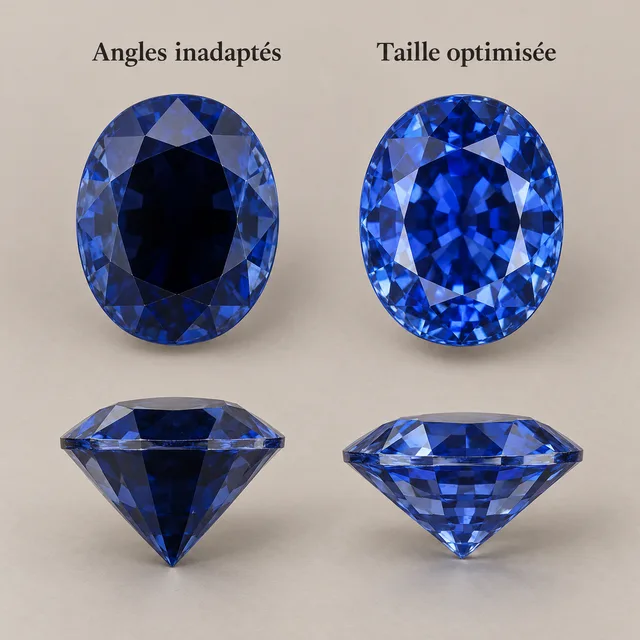
I Never dark
Poorly chosen angles let light escape through the bottom: the stone goes dull. On my cuts, they are calculated to send it back to the eye.
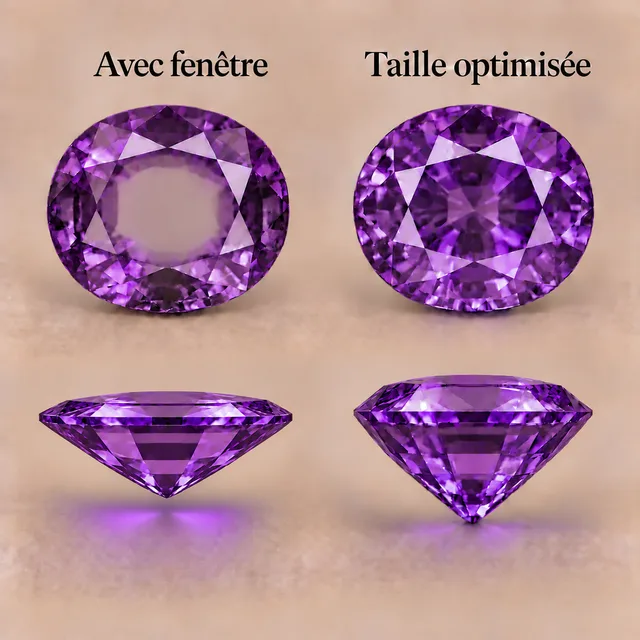
II No window
A “window” is the washed-out, see-through area in the centre of a poorly cut stone. Calculated angles avoid it.
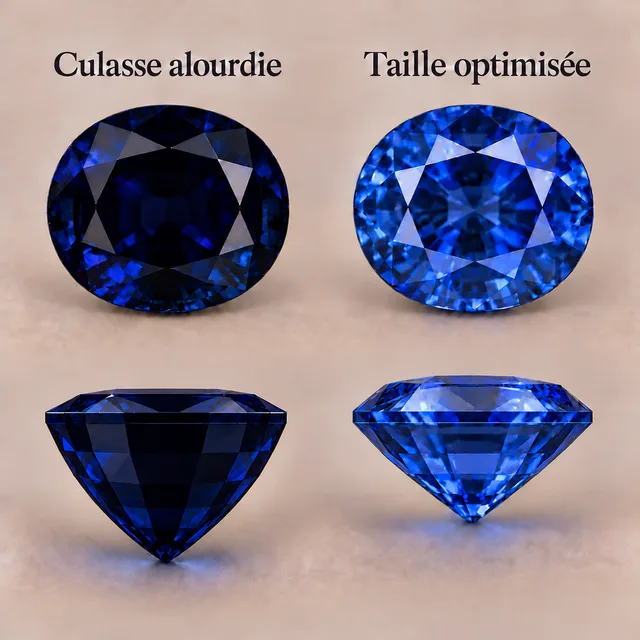
III No heavy pavilion
An oversized pavilion (the lower part) adds carats to the invoice, not brilliance. My proportions aim for beauty, not weight.
Stones I go and find myself
Most of my stones I go and find on site, in mines, rivers and quarries, alongside the miners and diggers, and, where it is allowed, digging myself. These journeys guarantee a known origin and field expertise that no certificate can replace: recognising good rough, judging its colour in daylight, anticipating what the cut will reveal.
Other stones are bought from suppliers chosen for their quality, then kept in stock to be recut at the workshop, refining their brilliance and lustre.
Emerald
I visited a private emerald mine with one of its co-owners and was able to dig in it myself, in the homeland of the world’s most sought-after emeralds.
Sapphire, ruby, garnet…
At the local markets, in Ratnapura among others, but also at the bottom of a mine, where I went down to work alongside the local miners.
Sapphire
I worked on a newly opened sapphire claim in the Rubyvale area: excavator, trucks, bobcat, trommel… from digging the gravel to sorting the rough by hand.
Emerald
Several summers spent searching for the emeralds of the Tyrol, sleeping in the mountain hut alongside fellow Austrian, German and Swiss prospectors.
Rock crystal, amethyst, sapphire, spinel, peridot
France has its gems too: rock crystal in the mines of the Alps; amethyst, sapphire, spinel and peridot in Auvergne, in rivers, fields and quarries.
Looking for a particular stone?
Tell me what you are after: I will find it for you, at the source.
Write to me →Current selection
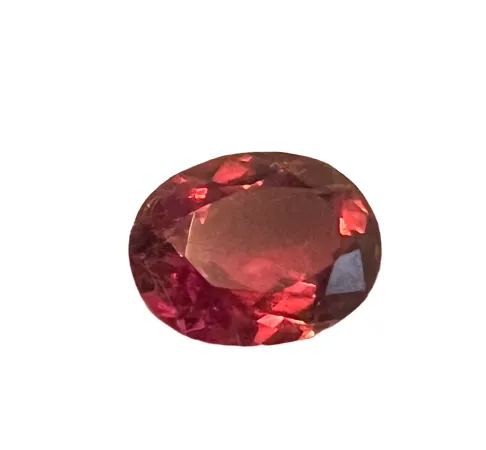 Madagascar Rubellite Oval
Natural rubellite from Madagascar, oval cut, with deep pinkish-red tones. A rare and elegant gemstone, perfec…
facet-001
€300
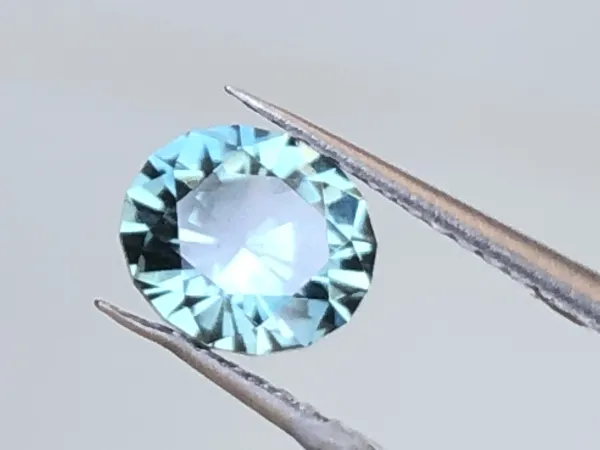 Auvergne Blue Sapphire Oval Cut
Natural sapphire from Auvergne with a luminous light blue color, oval cut. A rare and authentic French gemsto…
facet-002
€450

The bench pin
The cheville, or bench pin, is the wooden peg fixed to the jeweller's workbench. Against it the stone is fitted, the metal filed, the jewel shaped. The house bears its name.
Discover the house